Rent-to-Own Shed vs Financing vs a Storage Unit: The Real Cost Math
Rent-to-own sheds cost the most but skip the credit check. Financing costs less if you qualify. A storage unit never ends. Real dealer math inside.
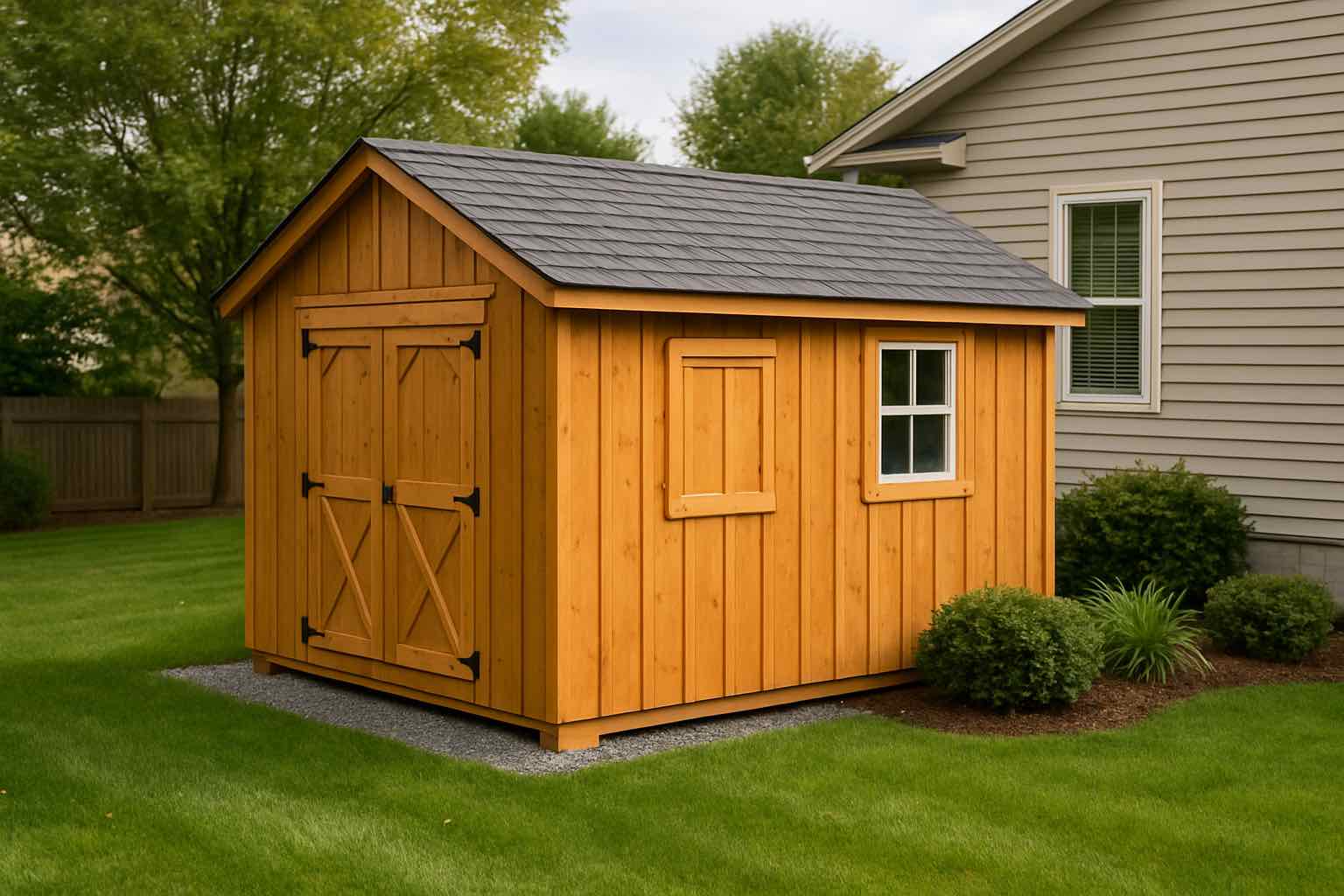
Photo from a rent-to-own shed dealer listed in the VRTO directory.
Rent-to-own costs the most in total, but it is the route dealers advertise with no credit check and a return option. Shed financing costs less if you qualify for it. A storage unit is cheaper month to month, but you own nothing at the end, ever. That is the whole comparison in three sentences. The rest of this guide is the actual math, using real advertised prices from named dealers, because the numbers change the decision more than any sales pitch does.
One thing before the math: VRTO doesn't sell sheds, doesn't sell loans, and takes no cut of any lease. We are a rent-to-own directory. Every page that currently ranks for shed financing questions is written by a company that sells sheds, so treat this as the version with no inventory to push. You can find a rent-to-own shed dealer near you on VRTO when you're done here.
The four ways to pay for a shed
Cash. You pay the advertised price plus tax and you own the building the day it lands. Cheapest by definition. The only question is whether pulling that much cash out is worth it to you.
Shed financing. A loan or retail installment contract. Lenders run a credit check, set a fixed payment, and charge interest. It typically involves a credit application and monthly reporting. If you qualify at a decent rate, the total lands well below rent-to-own.
Rent-to-own. You rent the building month to month on a nominal 36, 48, or 60-month schedule: you renew each month, and ownership transfers after the final renewal. The major programs behind shed dealers, RTO National, Heartland Capital Investments, Graceland, and Cook, all advertise the same core terms: no credit check (a government ID is what gets verified), the option to return the building, and early payoff anytime with a term-based discount. That structure is why dealers advertise no credit check, and it is also why the total cost runs high. We cover the approval side in our guide to no-credit-check shed programs.
Don't buy: rent a storage unit. You are not acquiring anything. You rent space by the month, you can leave whenever you want, and the payment never ends and never converts to ownership. For short-term storage that can be exactly right. For year-after-year storage it is the quiet money loser, because there is no finish line.
The comparison table
The worked example below uses one dealer's own published pair of prices so the routes are compared on the same building: Probilt Sheds (Specialty Products Industries, Safford, AL) advertises its 12x24 lofted barn at $8,250 cash or $359 per month on a 24-month rent-to-own term, as advertised in July 2026. The storage-unit row uses Public Storage's advertised 10x10 online rate of about $137 per month, as advertised in July 2026. These are advertised numbers, not quotes, not averages; terms vary by dealer and by finance company, and the loan column is illustrative math, not an offer.
| Route | Upfront | Credit check? | Monthly shape | What you own at the end | Exit option | Total on the 12x24 example |
|---|---|---|---|---|---|---|
| Cash | Full price + tax | No | None | The building, day one | Sell it | $8,250 + tax (Probilt advertised cash price) |
| Financing | Down payment · loan approval | Yes · credit application | Fixed installment until payoff | The building · lender interest until payoff | Pay off or sell | About $10,517 at an illustrative 10% APR over 60 months ($175.29/mo · illustrative only) |
| Rent-to-own | First payment · advertised down payments run $100 to $750 at the dealers cited below | Dealers advertise none · ID verification (per RTO National, Heartland, Graceland, Cook published terms) | Month-to-month renewals on a 24 to 60-month schedule | The building, after the final renewal | Return anytime · early payoff anytime with discount | $8,616 + fees and tax as published ($359 x 24 · Probilt advertised program) |
| Storage unit | First month · fees vary by operator | No loan involved | Monthly rent, indefinitely | Nothing, ever | Move out anytime | No endpoint · about $137/mo (Public Storage 10x10, advertised July 2026) x every month you keep storing = ~$8,220 over 60 months and climbing |
Notice something about that Probilt example: $8,616 against $8,250 cash is only about 4% over the cash price. Short terms are like that. The multiple that gives rent-to-own its reputation shows up on the long terms, which is the next section.
Where rent-to-own costs more, in plain numbers
Stretch the term and the total-of-payments climbs. Milledgeville Sheds and Trailers (shedsofmilledgeville.com), Milledgeville, GA, publishes the full multi-term grid on its 14x40 lofted barn cabin, so you can watch it happen on one building: $17,378.25 cash, or $847.39 per month for 36 months ($30,506 total, about 1.76x cash), or $621.42 per month for 60 months ($37,285 total, about 2.15x cash), all as advertised in July 2026.
The same pattern holds on small buildings. Bob's Buildings and More in Pacific, MO advertises an 8x12 metal shed at $2,150 cash, with rent-to-own at $99.54 for 36 months ($3,583 total), $89.58 for 48 months ($4,300 total), or $79.63 for 60 months ($4,778 total, about 2.2x cash), as advertised in July 2026. The 60-month option has the friendliest monthly payment and the worst total. That is the trade every long rent-to-own term makes, and dealers print it right on the page if you multiply it out.
There is a pressure valve: the programs advertise early-payoff options with term-based discounts, and you can exercise them at any point. Pay a 60-month contract off in month eight and you do not pay anywhere near the 60-month total. The published terms at RTO National, Heartland, Graceland, and Cook all include early purchase without penalty. If you take a long term for the low payment, the early-payoff table in your contract is the most valuable page in it.
Where rent-to-own wins anyway
Rent-to-own is a mainstream way to buy a shed, not a fringe one: Cook Portable Warehouses says 7 out of 10 of its customers choose its rent-to-own program. Here is what those customers are buying:
No credit check. Dealers advertise approval on a government ID and the first payment. RTO National, Heartland, Graceland and Cook all publish that their programs involve no credit check. For anyone with a thin or damaged credit file, this is often the only route to a building at all.
Return option. Every major program advertises a walk-away option: you can stop renewing and return the building. Ask the dealer, in writing, what charges, if any, apply when you return it. Financing does not include a return option. If your income is uneven or the need might not last, the month-to-month structure dealers advertise is a real feature.
The storage-unit crossover. An 8x12 shed is 96 square feet, roughly the footprint of a common 10x10 storage unit. Bob's Buildings' advertised $79.63 per month buys that footprint in your own backyard, and the payments stop at month 60 with the building owned. A storage unit's rent stops never: Public Storage advertises a 10x10 online at about $137 per month, as advertised in July 2026, and that number rolls on forever. Multiply your local unit rate by five years and set it against the shed's total-of-payments: the unit has no number in the "what you own" column, and after the shed's final payment its monthly cost drops to zero while the unit's keeps running. If you will store things for years, the math bends hard toward owning the space, even at rent-to-own's premium.
Match the route to your situation
If you have the cash, buy the building. Nothing else in this guide beats the advertised cash price, and every dealer cited here publishes one.
If your credit is solid and you can wait for approval, financing splits the difference: a real credit check and a bureau record, but a total far below a 60-month rent-to-own schedule at any typical loan rate.
If your credit file is thin, damaged, or you just refuse to put it on the line, rent-to-own is the route built for you. Take the shortest term you can carry, and read the early-payoff table before you sign.
If the need is short-term or genuinely uncertain, the return option is the feature you are actually buying. Price rent-to-own like a rental with an option, not like a purchase.
If you are storing for under a year, a storage unit may beat both, because you skip delivery, site prep, and any long total. Past a year or two, run the crossover math above before you renew again.
Whichever route you pick, the building type and size move the payment more than anything else; our guides to rent-to-own building types and shed sizes with real advertised prices carry the per-type and per-size numbers.
How to verify it yourself
- Demand the total-of-payments in writing. Monthly x term, plus fees and tax. Any dealer who resists that multiplication is telling you what it says.
- Ask one question: "Is this a loan or a rental-purchase agreement?" The answer determines whether there is a credit check and what your exit looks like.
- Price the same building in cash at a second dealer. The cash price is the anchor for every other number; make sure the anchor itself is fair.
- Read the early-purchase-option table in the contract. It is where a long-term contract stops being expensive, and the published programs all have one.
- Compare against 12 months of a storage unit near you, using the operator's own published rate for a similar footprint, and remember which column ends and which one doesn't.
FAQ
Do rent-to-own sheds have interest? Dealers and their finance companies advertise these as rental agreements with no interest rate; there is no APR quoted. The cost shows up as the gap between the total-of-payments and the cash price, which is why that gap, not a rate, is the number to compare. On the dealer examples above it runs from about 4% on a 24-month program to over 100% on 60-month terms. Confirm how your specific agreement is structured with the dealer and your state.
Are rent-to-own sheds worth it? They are the most expensive way to end up owning the building and the most flexible way to get one. Milledgeville Sheds and Trailers' own published grid shows a 14x40 cabin at $17,378.25 cash versus $37,285 in total 60-month payments. If you can pay cash or qualify for financing, take that instead. If you can't, or the return option genuinely matters to your situation, rent-to-own is the honest price of that flexibility.
Can I pay a rent-to-own shed off early? Yes. The programs behind shed dealers (RTO National, Heartland Capital Investments, Graceland, Cook) advertise early-payoff options with no penalty and term-based early-purchase discounts. Paying off early is the single biggest lever for cutting the total cost of a long contract.
Is shed financing hard to get? Lenders advertise it with a credit check and a credit application, so approval depends on your credit. Dealers advertise rent-to-own with no credit check, which is why the two routes price so differently for the same building.
What does "no money down" really mean? Usually that your first month's payment starts the contract, though advertised down payments vary dealer to dealer: Bob's Buildings lists a $100 deposit on its 8x12, Maco Sales of Warner Robins, GA advertises "Only $250 Downpayment" on a repossessed 12x32 garage ($7,500 cash, payments from $283.33 per month), and Milledgeville Sheds and Trailers lists $750 down on its 14x40 cabin, all as advertised in July 2026. Get the exact amount due at signing in writing.
Is a shed cheaper than a storage unit long-term? Over multiple years, usually yes, because shed payments end and unit rent doesn't. Compare a similar footprint (an 8x12 shed is 96 square feet, close to a 10x10 unit), take the unit operator's published monthly rate, and multiply by the years you expect to store. The shed's total is capped; the unit's total is your rate times forever.
Sources: the loan-column APR is illustrative math, not an offer. Nothing here is legal advice; confirm anything specific with the dealer and your state. Every price is an individual dealer's own publicly advertised figure as of July 2026, with the dealer named and linked in the text above. Prices are examples, not quotes or averages, and change often; confirm current terms with the dealer.
About this guide. VRTO (Virtual Rent To Own) is a rent-to-own store directory. We are not a lender, dealer, retailer, attorney, or financial advisor, and we take no part in any lease. This guide is general information to help you shop and compare, not legal, financial, or tax advice. Rent-to-own programs, fees, credit-reporting practices, and consumer protections vary by company and by state and change over time. Always read your own agreement and confirm the current terms and your rights with the store and, where it matters, a qualified professional in your state before you sign.
Plus updates if the rules change. Never shared with stores. Unsubscribe anytime.
See the totals for your item
Compare weekly price, full total, and early payoff across rent-to-own stores near you.